The Alphabet Soup of Efficiency
Air conditioning specifications include SEER, SCOP, EER, and various numbers that seem deliberately confusing. These ratings matter, they determine running costs, environmental impact and whether you’re buying efficient equipment or energy-wasting junk.
Let’s translate the jargon into language humans actually speak.
EER: Energy Efficiency Ratio
EER measures cooling efficiency at a single operating point, usually 35°C outdoor temperature. It’s the ratio of cooling output to electricity input. An EER of 3.5 means you get 3.5 units of cooling for every unit of electricity consumed.
Higher EER is better. Modern systems achieve EER of 3.0-4.5. Anything below 3.0 is inefficient. Premium systems exceed 4.0.
EER is useful for comparing systems but doesn’t tell the whole story. Real-world conditions vary outdoor temperature changes, humidity fluctuates, systems cycle on and off. EER only describes one specific scenario.
SEER: Seasonal Energy Efficiency Ratio
SEER measures cooling efficiency across an entire season, accounting for varying outdoor temperatures and part-load operation. It’s more representative of actual performance than EER.
SEER ratings typically range from 4.0 to 10.0+. European regulations require minimum SEER of 3.5 for split systems. Quality residential systems achieve SEER of 6.0-8.5. Premium units exceed 9.0.
Higher SEER directly translates to lower running costs. A system with SEER 8.0 costs roughly 30% less to operate than a system with SEER 6.0 in identical conditions. Over 15 years that’s hundreds of pounds saved.
SCOP: Seasonal Coefficient of Performance
SCOP measures heating efficiency, how effectively your air conditioning heats during winter. Like SEER, it accounts for varying conditions across an entire season.
SCOP ratings typically range from 3.0 to 5.5. A SCOP of 4.0 means you get 4 units of heat for every unit of electricity consumed, four times more efficient than electric heaters.
Modern heat pump systems achieve SCOP of 4.0-4.8. This efficiency makes air conditioning heating far cheaper than oil, LPG, or electric alternatives. It’s why heat pumps qualify for government grants—they significantly reduce carbon emissions and energy costs.
What These Ratings Mean in Practice
Real numbers help more than abstract ratings.
Low Efficiency Example: SEER 5.0, SCOP 3.0 Cooling season costs (June-August, living room use): £70-90 Heating season costs (December-February, supplementary heating): £140-180 Annual total: £210-270
High Efficiency Example: SEER 8.5, SCOP 4.5 Cooling season costs: £40-55 Heating season costs: £90-110 Annual total: £130-165
The efficient system saves £80-105 annually. Over 15 years that’s £1,200-1,575 saved. Initial purchase price difference is usually £300-500. The efficient system pays for itself in 3-5 years then continues saving money.
Energy Labels Simplify Comparison
European energy labels grade systems A+++ to G for both cooling and heating. This simplifies comparison—higher letters mean better efficiency.
A+++ systems have SEER above 8.5 and SCOP above 5.1. These are premium units with exceptional efficiency. A++ systems (SEER 6.1-8.5, SCOP 4.6-5.1) are also excellent. A+ and A ratings (SEER 5.1-6.1, SCOP 4.0-4.6) represent good efficiency.
Avoid anything below A rating unless price is absolutely critical and you rarely use the system. The running cost difference quickly exceeds the purchase savings.
Inverter Technology Makes the Difference
High SEER and SCOP ratings come from inverter technology. Traditional air conditioning runs at fixed speed, either full power or off. Inverter systems adjust compressor speed continuously, matching output to actual demand.
This variable speed operation dramatically improves efficiency. Instead of repeatedly starting and stopping (which wastes energy), inverter systems run continuously at lower power levels. They maintain precise temperature while using less electricity.
All our Mitsubishi Heavy Industries, Samsung, and Daikin systems use inverter technology. It’s standard in quality equipment but worth confirming when comparing quotes.
Don’t Ignore Noise Ratings
Efficiency isn’t everything. Noise levels matter, especially for bedroom installations. Ratings are in decibels (dB).
Whisper-quiet systems operate at 19-25 dB indoors, quieter than a library. Good systems run at 25-35 dB. Anything above 40 dB is noticeably loud and unsuitable for bedrooms.
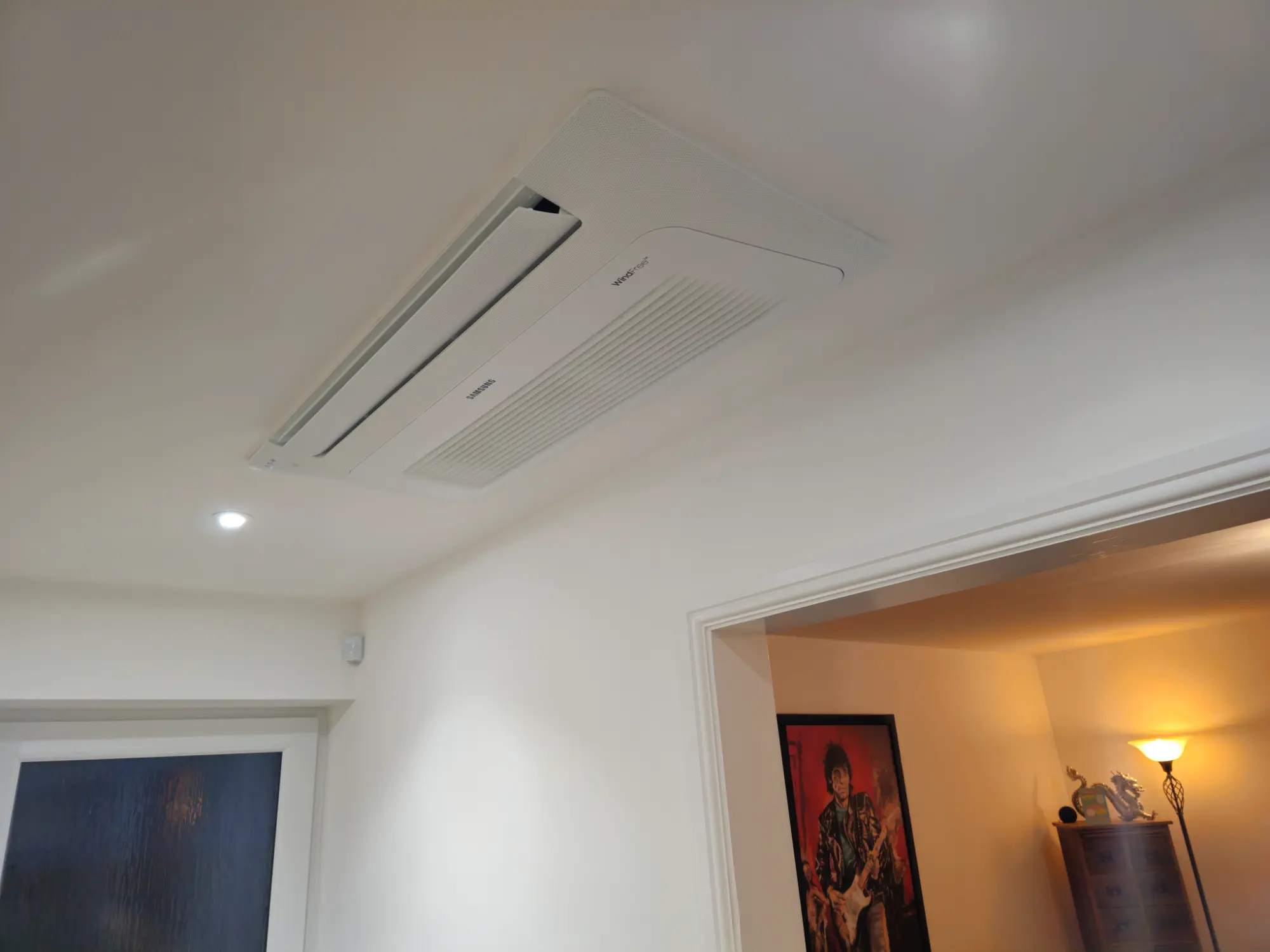
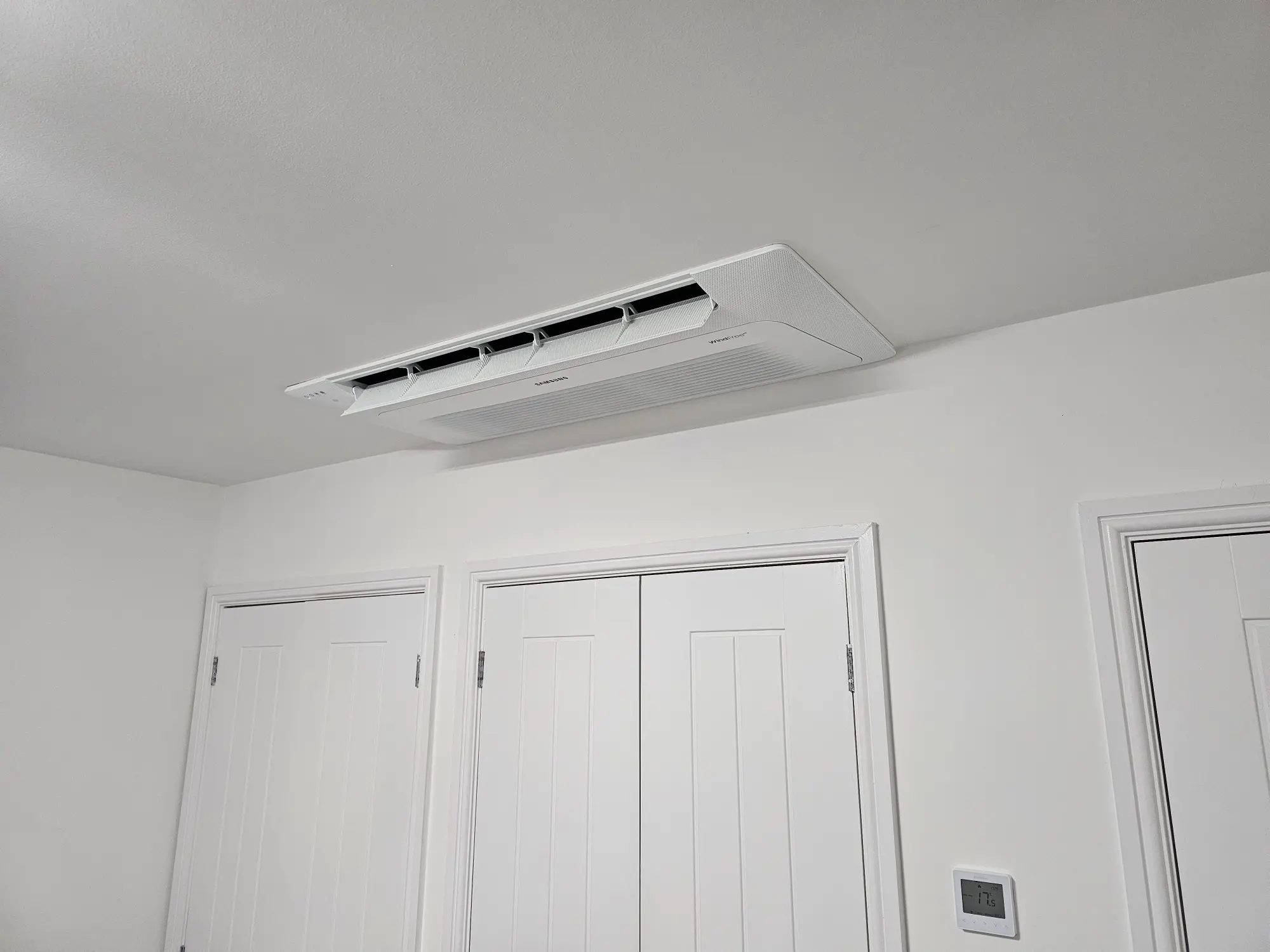
Our premium Samsung WindFree™ systems achieve 21 dB in quiet mode genuinely silent operation for undisturbed sleep.
Capacity Ratings: kW and BTU
Cooling and heating capacity is measured in kilowatts (kW) or British Thermal Units (BTU). One kW equals approximately 3,400 BTU.
Typical bedroom units are 2.5-3.5 kW (8,500-12,000 BTU). Living rooms need 3.5-5.0 kW (12,000-17,000 BTU). Larger spaces require 5.0-7.0 kW (17,000-24,000 BTU) or multiple units.
Undersized systems run constantly without reaching comfortable temperature. Oversized systems short-cycle, wasting energy and providing poor humidity control. Proper sizing based on room dimensions, insulation, and usage is essential.
Smart Features Boost Real-World Efficiency
Ratings measure potential efficiency. Smart features deliver it in practice.
Wi-Fi control lets you schedule operation, avoiding unnecessary running. Presence sensors detect occupancy and adjust output automatically. Intelligent defrost cycles minimise wasted energy during heating mode. Adaptive learning anticipates your patterns and pre-adjusts temperature.
These features can improve real-world efficiency by 10-20% compared to basic operation, even with identical SEER/SCOP ratings.
Why We Stock Premium Brands
Mitsubishi Heavy Industries, Samsung, and Daikin consistently achieve the highest efficiency ratings with proven reliability. We could offer cheaper brands with lower ratings, initial cost would be less but lifetime value would be worse.
Our customers save more money over system lifespans by starting with efficient equipment. It’s honest advice that serves your interests, not ours.
The Bottom Line
SEER and SCOP measure efficiency, higher numbers mean lower running costs and reduced environmental impact. Aim for SEER above 6.5 and SCOP above 4.0 for good value. Premium systems exceeding SEER 8.0 and SCOP 4.5 deliver exceptional long-term savings.
During consultations, we explain efficiency ratings for recommended systems and calculate estimated running costs specific to your usage patterns. You’ll know exactly what efficiency means for your electricity bills.
Efficient air conditioning isn’t expensive, inefficient air conditioning is. The difference reveals itself over years, not weeks. Choose wisely.