Temperature Directly Affects Productivity
Research consistently demonstrates cognitive performance declines above 24°C. Response times slow, error rates increase, concentration diminishes. For knowledge workers, comfortable temperature isn’t a perk, it’s a performance requirement.
A 20-person office where everyone’s 5% less productive due to uncomfortable temperature equals losing one full-time employee’s output. The cost of poor climate control exceeds the investment in proper air conditioning rapidly.
The Office Temperature Debate
Every office has the temperature wars. Some people are too hot while others reach for cardigans. This isn’t solvable by finding the “perfect” temperature, individual thermal comfort varies based on metabolism, clothing, activity level, and desk location.
Effective office air conditioning acknowledges this reality. Multi-zone systems allow different areas to maintain different temperatures. Employees near windows (solar gain) can have cooler settings than internal desks. Meeting rooms used intermittently get different control than constantly occupied workspaces.
Heat Load Sources in Offices
Modern offices generate substantial heat that air conditioning must remove.
Occupants: Each person produces 100-120 watts of heat. Twenty employees generate as much heat as running two bar heaters continuously.
IT Equipment: Computers, monitors, servers, printers, and networking equipment all produce heat. A typical office with one computer per desk generates 50-80 watts per square meter from IT alone.
Lighting: LED lighting reduced heat loads significantly compared to old fluorescent or halogen, but still contributes. Older offices with inefficient lighting generate substantial heat from illumination.
Solar Gain: Windows facing south or west create enormous heat gain during summer. Glass-fronted buildings particularly struggle, the greenhouse effect can raise internal temperatures 5-10°C above ambient.
Equipment Rooms: Server rooms, comms rooms and printer areas concentrate heat-generating equipment requiring dedicated cooling.
Office Air Conditioning System Types
VRV/VRF Systems: Variable refrigerant volume systems excel in office environments. One outdoor unit serves multiple indoor units (typically 10-50+) with individual zone control. Different offices, meeting rooms and open-plan areas maintain different temperatures independently.
Heat recovery VRV systems transfer waste heat from sunny offices or server rooms to heat cooler areas, exceptional efficiency. Perfect for medium to large offices requiring flexible climate control.
Multi-Split Systems: Smaller offices benefit from multi-split systems, one outdoor unit serving 2-5 indoor units. More affordable than VRV while providing zone control for different areas.
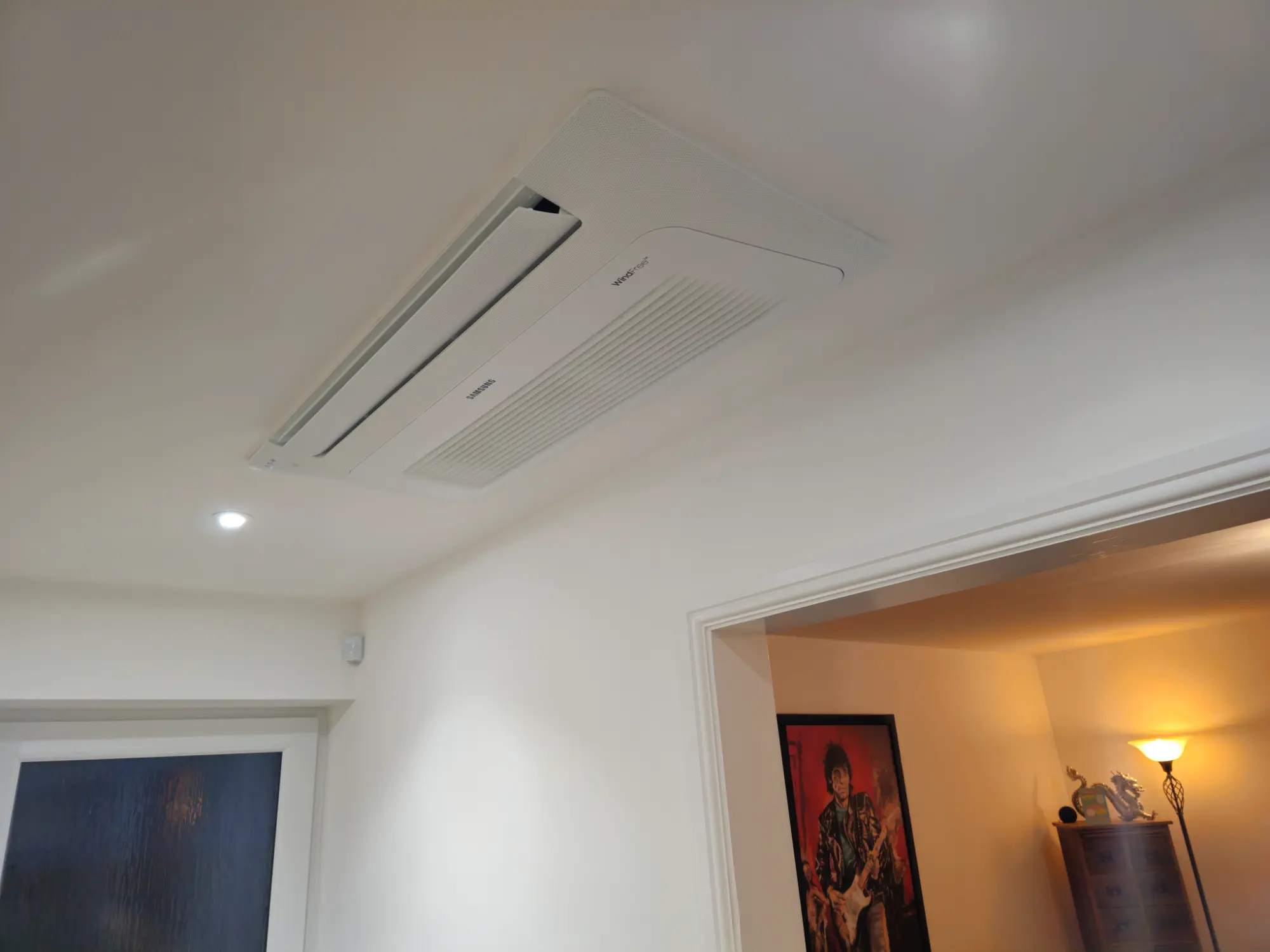
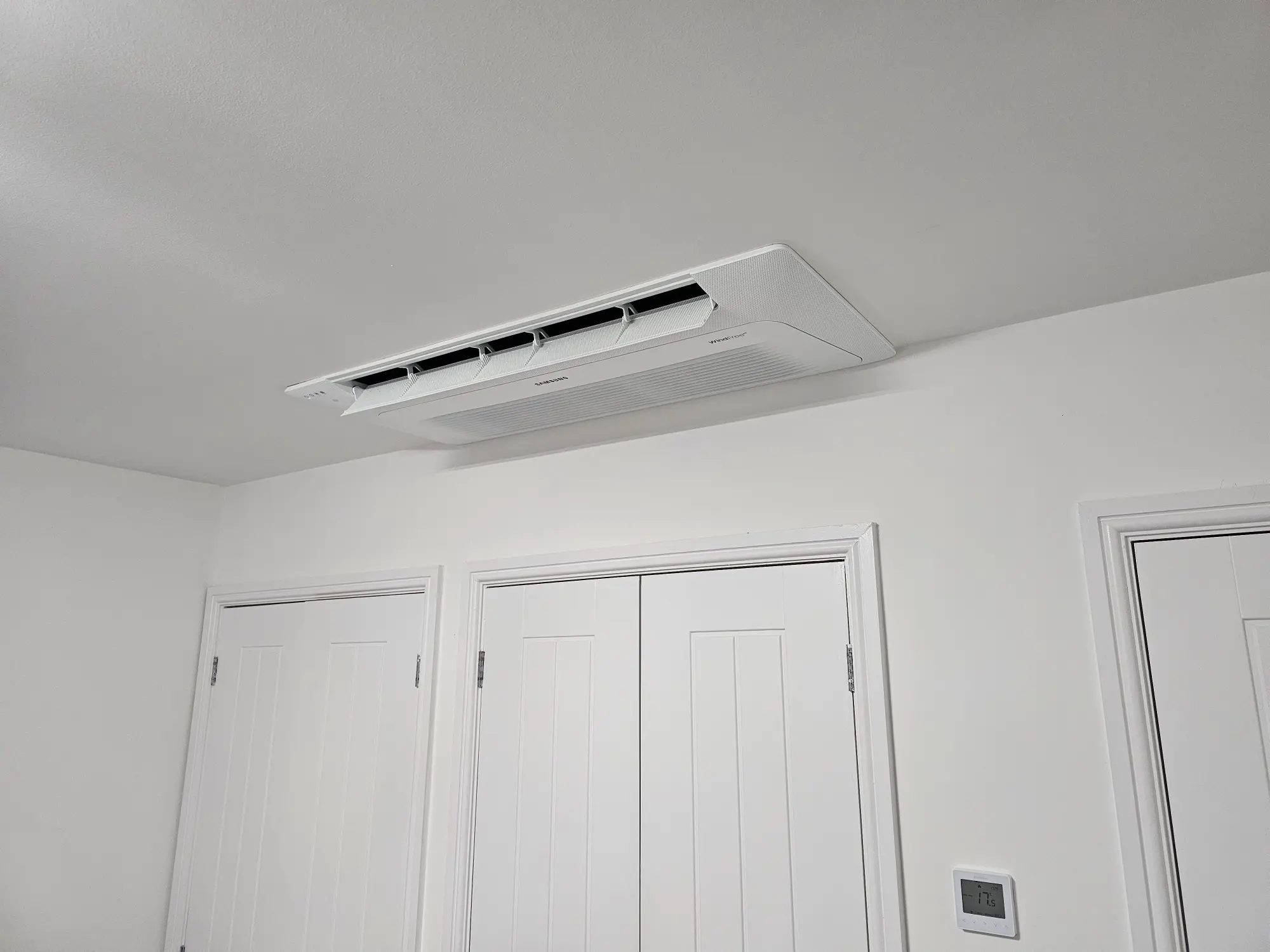
Ceiling Cassettes: Four-way cassette units suit open-plan offices beautifully. Mounted in suspended ceilings, they distribute air evenly without occupying wall space. Discrete appearance maintains professional office aesthetics.
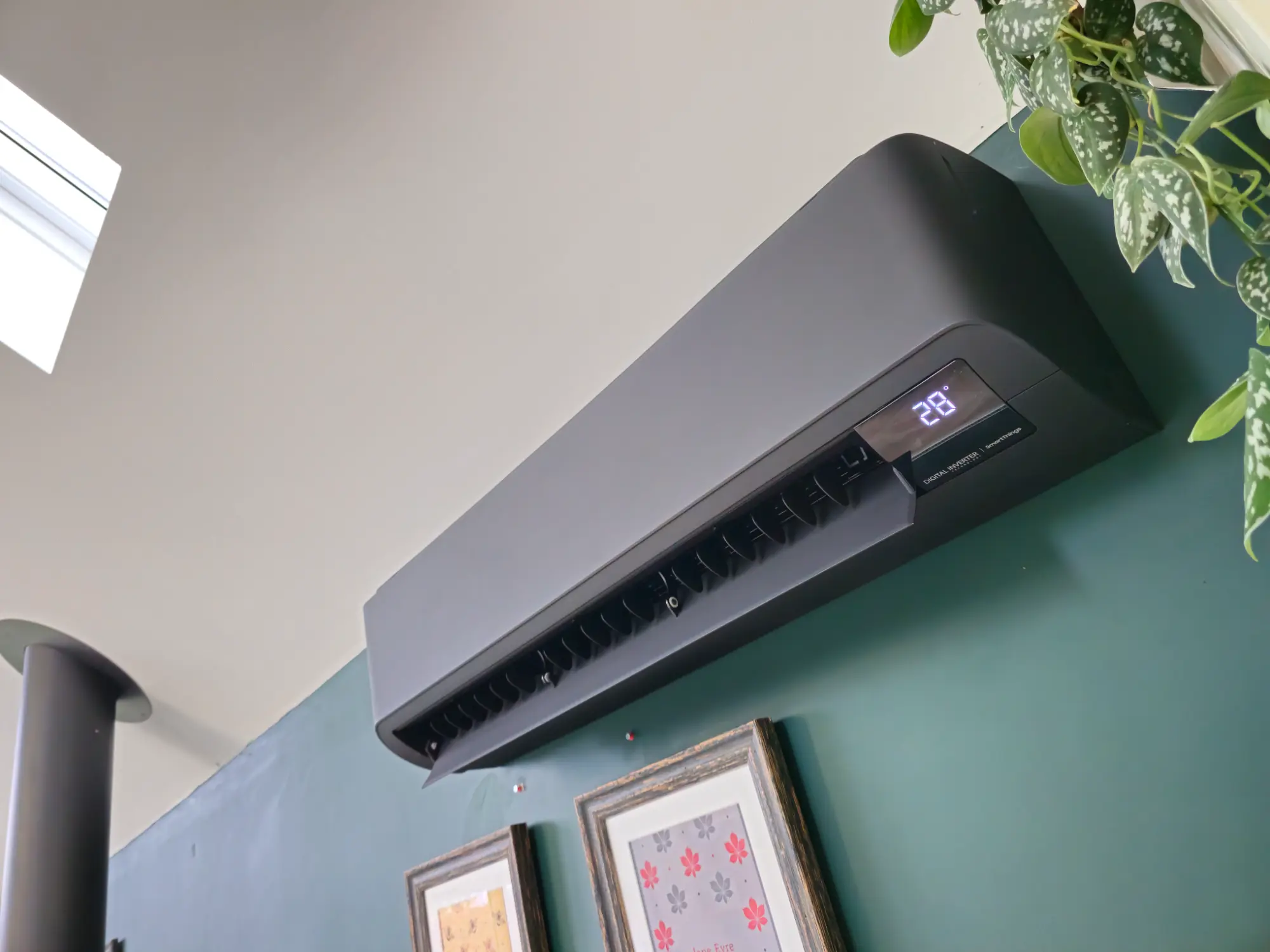
Wall-Mounted Units: Cost-effective for smaller offices or individual rooms. Modern units achieve sleek appearance blending with office décor. Quiet operation (35-40 dB) maintains professional environment.
Ducted Systems: Completely hidden systems with only vent grilles visible. Provides uniform appearance and good air distribution. Requires suspended ceiling with adequate void space.
Capacity Calculation for Offices
Standard calculation: 100-150 watts per square meter for typical office spaces. This accounts for average occupancy, IT equipment, and lighting.
Adjust for specific circumstances:
- High-density occupancy (call centres): 150-180 watts/m²
- Heavy IT use (design studios, developers): 120-160 watts/m²
- Server rooms: 300-500 watts/m² minimum
- Meeting rooms: 120-150 watts/m² (higher occupancy but intermittent)
- Reception areas: 100-120 watts/m² (lower density)
Professional heat load calculations account for building orientation, window area, insulation, occupancy patterns and equipment. These calculations ensure properly sized systems that maintain comfort without wasting money on excessive capacity.
Zone Control Strategy
Effective office air conditioning divides spaces into logical zones:
Perimeter Zones: Areas within 4-5 meters of external walls experience solar gain and heat loss. These zones need independent control from internal areas.
Internal Zones: Core office areas without external exposure remain more stable. Often require less cooling capacity but benefit from consistent temperature control.
Meeting Rooms: Intermittent high occupancy requires different approach. Pre-cooling before meetings, ramping up during occupancy, reducing when empty.
Server/Equipment Rooms: Dedicated cooling maintaining 18-22°C regardless of other areas. Often require 24/7 operation even when office is closed.
Individual Offices: Private offices benefit from independent control. Senior staff often expect ability to adjust their office temperature.
Energy Efficiency in Office Applications
Office air conditioning operates 8-12 hours daily, 250+ days annually. Efficiency differences compound into substantial cost variations.
Target SEER above 7.0 for commercial office applications. Inverter-driven systems essential, variable speed operation dramatically reduces energy consumption compared to fixed-speed equipment.
Occupancy sensing reduces waste. Systems detecting empty offices or meeting rooms automatically reduce output, maintaining setback temperature while minimising energy use.
Smart scheduling aligns operation with occupancy. Systems pre-cool offices before staff arrive, maintain comfort during working hours, reduce to setback temperature after hours, and shut down weekends if offices are closed.
A 500m² office spending £2,500 annually on air conditioning with SEER 6.0 could reduce costs to £1,750 with SEER 8.5 equipment, £750 annual saving, £11,250 over 15 years.
Noise Considerations
Office environments demand quiet air conditioning. Staff on phone calls, virtual meetings or concentrated work need minimal acoustic disruption.
Specify systems achieving 35-40 dB maximum in office areas. Quality commercial units achieve this easily. Reception areas benefit from even quieter operation (30-35 dB) maintaining professional first impressions.
Avoid positioning indoor units directly above desks where occupants sit continuously. Distribute units to provide even coverage without creating uncomfortable drafts or noise hotspots.
Air Quality and Ventilation
Air conditioning and ventilation serve different purposes but must work together.
Air conditioning controls temperature and humidity. Ventilation provides fresh air, removing CO2 and maintaining air quality. Modern offices need both.
Building regulations require minimum fresh air supply rates based on occupancy. Air conditioning doesn’t satisfy this requirement, dedicated ventilation or opening windows provides necessary fresh air.
Some air conditioning systems include fresh air intake, combining ventilation and climate control. This integrated approach ensures air quality while maintaining temperature but requires more complex installation.
Installation Planning
Office air conditioning installation requires minimal business disruption.
Timing: Schedule major installation during planned office closures, holidays or weekends. Most installations complete outside normal working hours to maintain business continuity.
Access: Internal units often install in suspended ceiling voids. External units typically position on roofs, external walls, or ground-level plant areas. Access to both is essential during installation.
Electrical Supply: Office air conditioning requires adequate electrical capacity. Older buildings may need electrical upgrades to support new systems. Factor this into project planning and budgets.
Duration: Small offices (10-20 desks) typically require 2-3 days installation. Medium offices (20-50 desks) need 4-7 days. Large installations (50+ desks) may take 1-3 weeks depending on complexity and phasing requirements.
Ongoing Maintenance Requirements
Commercial office air conditioning requires regular professional maintenance.
Quarterly Service: High-use office systems benefit from quarterly maintenance, filter cleaning, performance checks, refrigerant verification, drainage clearing.
Biannual Minimum: Less intensive use may allow biannual servicing. However, quarterly filter checks remain essential in dusty environments or high-occupancy offices.
Annual Deep Service: Comprehensive annual service including coil cleaning, electrical testing and full performance verification.
Service contracts provide scheduled maintenance, priority breakdown response and predictable budgeting. For businesses depending on comfortable office environment, contracts are essential.
Smart Controls and Integration
Modern office air conditioning integrates with building management systems.
Scheduling: Automated operation aligning with business hours. Different schedules for weekdays, weekends, holidays. Override functions for exceptional circumstances.
Remote Monitoring: Cloud-based systems alert maintenance teams to developing problems before complete failure. Preventive intervention reduces downtime.
Occupancy Integration: Systems responding to actual occupancy patterns rather than fixed schedules. Empty offices reduce to setback temperature automatically.
Energy Reporting: Detailed consumption data identifies optimisation opportunities and demonstrates environmental commitment.
Costs and Investment Returns
Office air conditioning budgets vary substantially based on size and complexity.
Small office (10-20 desks, 100-200m²): £6,000-12,000 Medium office (20-50 desks, 200-500m²): £12,000-25,000 Large office (50-100 desks, 500-1,000m²): £25,000-50,000+
These investments deliver returns through:
Productivity Gains: 5-10% productivity improvement from optimal temperature equals substantial value. For high-salary knowledge workers, this quickly justifies air conditioning investment.
Staff Retention: Comfortable working environment reduces turnover. Recruitment costs £3,000-8,000 per employee depending on role. Retaining staff through better conditions saves money.
Reduced Sick Days: Overheated offices correlate with increased sick leave. Temperature-related absence costs UK businesses millions annually.
Energy Savings: Replacing old inefficient systems or supplementing expensive electric heating with heat pump technology reduces operating costs.
Heat Pump Functionality
Office air conditioning provides efficient heating during winter. Heat pump operation delivers 3-4 units of heat per unit of electricity consumed, far more efficient than electric or oil heating.
For offices currently using expensive electric heating, air conditioning with heat pump capability often pays for itself through winter heating savings within 3-5 years, while providing summer cooling as additional benefit.
Compliance and Documentation
Commercial air conditioning installation requires building regulations compliance, F-Gas certified engineers, and proper documentation.
Professional installers provide:
- Installation certificates
- F-Gas records
- Commissioning documentation
- Operating instructions
- Maintenance schedules
- Warranty activation
These documents satisfy health and safety requirements, support insurance coverage, and enable effective ongoing maintenance.
Choosing Office Air Conditioning
Successful office air conditioning balances comfort, efficiency, acoustics, aesthetics and budget.
During consultations we assess your office layout, calculate heat loads, discuss usage patterns, recommend appropriate systems, and provide detailed quotations including installation, commissioning, and ongoing maintenance costs.
You’ll understand exactly what you’re getting, why we’re recommending it, expected running costs, and maintenance requirements. Informed decisions based on your specific circumstances rather than generic solutions.
We’ve installed office air conditioning for solicitors, accountants, architects, technology companies, medical practices and administrative offices across Norfolk, Cambridgeshire and Lincolnshire. Our commercial team delivers solutions maintaining professional environments while protecting your investment.